
What is AR?
AR places digital assets over our view of the world in real-time so we can experience them both simultaneously. It differs from Virtual Reality (VR) in that it does not replace the spaces we inhabit with an entirely virtual environment.
Technologies that support AR
AR can be experienced through screen based devices like mobile phones and tablets or through head mounted displays (HMDs).
Various Kinds of AR
There are four main categories of AR technologies:
Marker-Based AR
Detects an object in front of the camera lens and provides information about the object.
Geo-Locational (Markerless) AR
Digital assets are tied to specific spaces using location information from the devices’ GPS, digital compass and accelerometer.
Projection AR
The projection of light on a surface. Projection-based AR can be used to deceive users about the position/orientation and depth of an object in the real world.
Superimposition Based AR
This AR presents the user with a replacement view of the object in focus with a full or partial augmented view.
Popular Examples of AR
Examples of AR that you may be familiar with include snapchat and facebook face filters which can be created using the web-based Lens and Spark AR softwares respectfully. Another example of AR which gained popularity in 2016 was the ‘Pokemon Go’ app which allowed users to explore their real-world environments in order to collect digital Pokemon in real time. A third example was Ikea’s AR catalogue which allowed users to scan images from the catalogue and place digital versions of their furniture in their surrounding environment.


The Future of AR
Below is a graph detailing the expected revenue to be generated by AR in different industries by 2025.
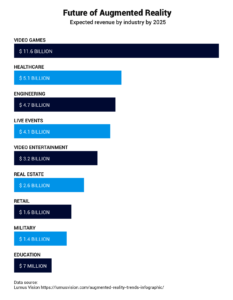
AR must separate itself from mobile devices in order for it to reach its’ true potential. We are seeing this already with the introduction of wearables such as the Google glass. After AR finds an enticing, fully developed platform and a vast number of customers are AR proficient, the potential of AR will begin to be fully realized. Every industry from education to sports, cultural heritage and tourism, military training, and retail commerce could benefit from the use of AR technology.